I get asked the same question most weeks, usually over coffee at the clubhouse: "Is Arabian Ranches 3 actually a good investment, or is it just a nice place to live?" The honest answer is that it can be both, but the two cases are not identical, and pretending they are is how people end up disappointed. I've sold and let property across Dubai for twenty years, and I live here in AR3 with my own family, so this guide is written from inside the community rather than from a sales desk.
What follows is the investment case as I'd give it to a friend: where the rental demand really comes from, how the capital growth story has played out, the difference between buying a completed home and an off-plan one, how to think about yield without me quoting you a number I can't stand behind, what exit liquidity looks like here, where the Golden Visa fits, and — just as importantly — the risks I'd want you to weigh before you commit.
One ground rule throughout. I will not quote you a live price, an AED/sqft figure or a current rent as fact, because those move and the only version worth acting on is the live data drawn from the Dubai Land Department and Property Monitor on each cluster page. Where I mention money, it's framed as history or general guidance — always verify before you sign anything.
Why investors look at AR3 in the first place
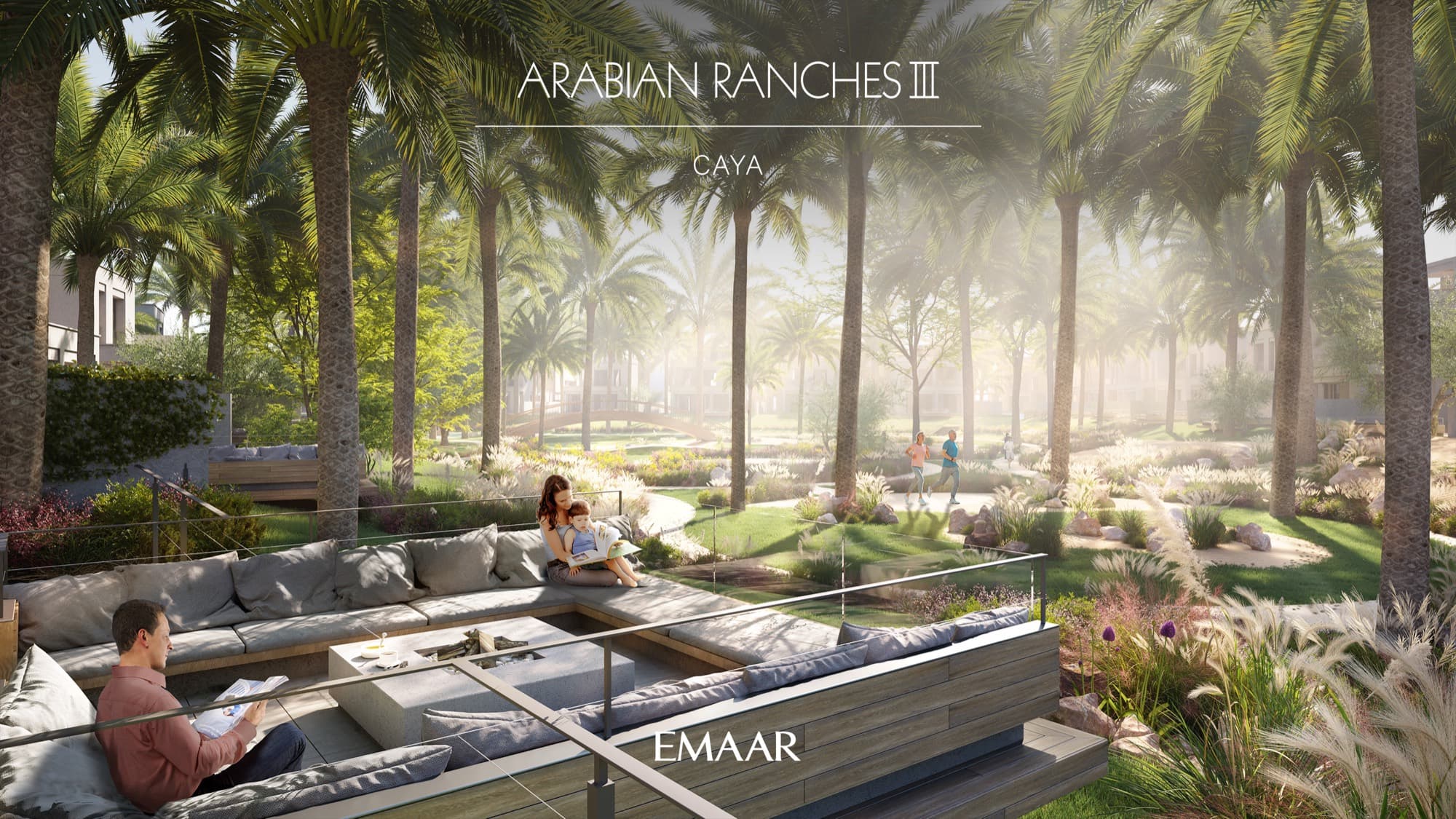
The simplest way to understand AR3 as an investment is to understand who wants to live here. This is a family community, full stop. It's a master-planned Emaar development off Sheikh Zayed Bin Hamdan Al Nahyan Street, built around a central park, a lazy river, a clubhouse, pools, padel and tennis courts, cycling and jogging tracks, children's play areas and a retail and food-and-beverage spine. People don't rent a four-bedroom townhouse here on a whim — they move in because they want space, schools and a community their children can grow up in. That gives the rental demand a stickiness you don't always find in apartment districts.
The Emaar name matters too, more than some investors expect. In a market with a lot of developers and a lot of promises, the established master-developers tend to hold value better and let more easily, because tenants and buyers trust the build quality, the community management and the long-term maintenance. AR3 sits in that bracket. It also benefits from a location that's genuinely improving: Global Village is about five minutes away, Downtown Dubai and DXB International Airport both sit around twenty minutes, The Dubai Mall is roughly thirty-five and Dubai Marina around thirty-five too. A real plus — and I'll be honest about it throughout — is that the Emirates Road (E311) exit serving AR3 is now open, giving the community direct access to both Emirates Road (E311) and Al Ain Road (E66).
That direct access is exactly what gives you the brisk connectivity times above. I mention it early because connectivity is one of the levers that moves both rent and resale value, and a delivered improvement like this is precisely what a thoughtful investor wants to see banked rather than still pending.
The rental demand engine: families and schools
If you take one thing from this guide, make it this: in a family community, schools are the single biggest driver of tenant demand, and AR3 is well served. Families plan their lives around the school run, and once children are settled they are reluctant to move, which is precisely the behaviour a landlord wants. Tenants who renew year after year mean fewer void periods, lower re-letting costs and a more predictable income.
There's a good spread of well-regarded schools within a sensible drive of AR3, spanning British and IB curricula. Names that come up regularly with my tenants and buyers include Ranches Primary School and Jumeirah English Speaking School (JESS) in the original Arabian Ranches, Fairgreen International School in The Sustainable City, the GEMS schools along Al Ain Road, Kent College Dubai, Repton, South View School and others. I'd always say verify the current KHDA inspection ratings yourself before you lean on a school as a selling point — ratings change, and an out-of-date claim helps nobody.
The practical upshot for an investor is to think about your tenant before you buy. A three or four-bedroom townhouse appeals to a wide pool of families and tends to let quickly. A larger five-bedroom villa is a smaller, more selective market — often a stronger long-term hold and a nicer home, but you may wait a little longer for the right tenant. Neither is wrong; they're just different propositions, and matching the property to realistic demand is what keeps a place occupied.
The capital growth narrative — what's reasonable to expect
Dubai property has had a remarkable run, and AR3 has ridden that wave. Several of the early clusters were launched at prices that, with hindsight, looked like good value, and the broader Dubai market saw strong appreciation through the post-2020 cycle. I won't hang a percentage on AR3 specifically as live fact — the only figures worth acting on are the transaction-based numbers on each cluster page, drawn from the DLD and Property Monitor — but the direction of travel for a well-located, well-built family community has been positive.
Where I'd urge caution is in extrapolating the past in a straight line. Markets are cyclical. The exceptional growth of recent years reflected a particular set of conditions, and no responsible broker should promise you a repeat. What I'd point to instead are the structural drivers that support value over time: a finite supply of family villas and townhouses in established Emaar communities, continued population growth in Dubai, an improving road network around AR3, and the maturing of the community itself as landscaping fills in, retail opens and amenities bed down.
There's also a quieter dynamic worth naming. A brand-new community trades partly on its launch story; a maturing one trades on lived reality. As clusters complete and families actually move in — turning render into neighbourhood — buyers can see what they're getting, and that tends to firm up pricing for the homes that show well.
Completed vs off-plan: two different strategies
This is the decision I spend the most time on with investors, because the two routes suit different goals and different temperaments. Both are legitimate; the mistake is choosing on instinct rather than on what you actually want from the money.
Buying completed means buying a home you can see, in a cluster that's already handed over — Joy, Sun, Spring, Ruba, Bliss, Caya and Anya are among those completed. You can walk the streets, judge the finish, and crucially you can let it from day one, so your income starts immediately. You pay the prevailing market price and you compete with other ready stock, but you carry no construction risk and no waiting. For an investor who wants rental yield now and certainty over excitement, completed is usually the cleaner answer.
Buying off-plan means buying into clusters still completing through 2025 and 2026 — among them Bliss 2, Caya 2, June and June 2, May, Raya, Anya 2 and the Elie Saab branded villas. The appeal is the payment plan, the lower entry point relative to ready stock at launch, and the prospect of appreciation between purchase and handover. The trade-offs are real: your capital is committed before you earn a dirham of rent, completion timelines can move, and the market can shift while you wait. If you go off-plan, read the SPA carefully, understand the payment milestones and the developer's track record, and treat any projected return as a scenario, not a promise. Our dedicated off-plan guide goes deeper on the mechanics.
A quick rule of thumb
If your priority is income from day one and you sleep better with certainty, lean completed. If you're comfortable committing capital ahead of returns in exchange for a payment plan and potential upside, and you've done your homework on the developer and timeline, off-plan can work well. Plenty of investors hold a bit of both.
Townhouse vs villa as an investment
AR3 gives you a genuine choice of asset type, and they behave differently as investments. The townhouse clusters — Joy, Sun, Spring, Ruba, Bliss and Bliss 2, May, Raya, Anya and Anya 2 — offer three and four-bedroom homes. The villa clusters are Caya and Caya 2 (three, four and five-bedroom standalone villas), June and June 2 (four and five-bedroom villas) and the Elie Saab Villas and Elie Saab Villas II (four and five-bedroom branded luxury villas).
Townhouses are, broadly, the liquidity play. The entry price is lower, the buyer and tenant pools are deeper, and they tend to transact and let more quickly. For a first investment in the community, or for an investor who values being able to exit cleanly, a well-positioned townhouse is hard to fault. Gross yields on townhouses are often a touch higher than on the larger villas, simply because rent doesn't scale up as fast as capital value does — but again, look to the live figures on the cluster pages rather than any number I'd quote here.
Villas, and especially the branded Elie Saab homes, are the capital and prestige play. Larger plots, higher specification and a more exclusive buyer pool can mean stronger long-term appreciation and a tenant willing to pay for quality, but the market is thinner, so both letting and selling can take longer and price discovery matters more. If you're buying a five-bedroom villa, buy a good one in a good position — the premium product rewards quality and punishes the ordinary.
Understanding yield, and thinking about your exit
Let's demystify yield, because it's where I see the most confusion. Gross yield is simply your annual rent divided by the purchase price, expressed as a percentage — a headline number that ignores costs. Net yield is the figure that actually matters: it takes that rent and subtracts the real costs of ownership — annual service charges, maintenance, any management fee, periods when the property sits empty, and the upfront transaction costs amortised over your holding period. Net yield is always lower than gross, and an investor who plans around the gross number is planning around a fiction.
I'm deliberately not quoting you a current yield for AR3, because it varies by cluster, by unit and over time, and the only honest source is the live, transaction-based data on each cluster page sourced from the DLD and Property Monitor. What I will say is: budget for service charges (we cover these in a dedicated guide), assume some void between tenants, and stress-test your numbers against a softer rental market, not just today's.
On liquidity — your ability to sell when you want to — AR3 scores well by villa-community standards, and that's a genuine advantage. Emaar's brand, the family demand and the depth of the townhouse market mean ready, well-priced homes generally find buyers. The qualifiers are the usual ones: smaller, cheaper townhouses are the most liquid; large bespoke villas take longer; and in any market, the home that's priced right and presents well sells, while the one chasing yesterday's price sits. If a clean exit is important to you, factor that into what you buy, not just what you pay.
Golden Visa, costs and the practicalities
AR3 is a designated freehold zone, so investors of any nationality can buy with full ownership — there's no requirement to partner with a local sponsor. That alone makes it accessible to the international buyers who make up a large part of the market here.
The Golden Visa is a real draw and worth understanding properly. A qualifying property investment at or above AED 2,000,000 in value can open the door to a ten-year renewable residency for the investor and, typically, their family — a meaningful benefit that turns a property purchase into a lifestyle and residency decision as well as a financial one. Many AR3 villas, and some larger townhouses, sit at or above that threshold. The rules and processing details do change, so confirm the current criteria with a specialist before you buy on that basis.
On the numbers you can plan around: budget the standard DLD transfer fee of 4% of the purchase price, plus agency and conveyancing or trustee costs. If you're financing, expatriate mortgages generally run up to around 80% loan-to-value for properties under AED 5 million and roughly 75% above that, with some off-plan purchases sitting lower — all general guidance to verify with a broker against your own profile, as terms move with the market and the regulator. Our Dubai mortgage and how-to-buy guides walk through the full process step by step.
The risks I'd want you to weigh
No guide written from inside the community would be complete without the honest counterweight, so here it is. First, market cyclicality: Dubai has delivered strong growth, but property markets rise and fall, and past performance is not a forecast. Buy at a price and on terms that still make sense if the market cools.
Second, off-plan and supply risk. Off-plan completion timelines can slip, and AR3 is still completing through 2025 and 2026, with new supply coming to market as clusters hand over. A wave of handovers can put short-term pressure on rents and prices in a given cluster, so timing and cluster selection matter. On the connectivity front, the picture is now a positive rather than a risk: the Emirates Road (E311) exit serving AR3 is open, so the community has direct access to both Emirates Road (E311) and Al Ain Road (E66) — a connectivity improvement that is now banked rather than pending.
Finally, the running-cost and liquidity realities I've already flagged: service charges and voids erode gross yield, larger villas can be slower to let and sell, and your net return depends on disciplined cost assumptions. None of these are reasons to avoid AR3 — I live here and I believe in the community — but they're the conversations a good broker has with you before the purchase, not after. If you'd like that conversation, with live cluster data in front of us, I'm always happy to talk it through.
Frequently Asked Questions
Investing in AR3 — FAQs
Is Arabian Ranches 3 a good investment?+
It can be, for the right investor and the right goal. AR3 has the ingredients that support both rental income and capital value: an established Emaar master-developer, a genuine family community built around parks and amenities, strong school-driven tenant demand, freehold ownership for all nationalities, and an improving location. It isn't a guaranteed win — markets are cyclical and running costs eat into yield — but as a long-term family-property hold in Dubai it stands up well. Check the live, transaction-based figures on each cluster page before committing.
What rental yield can I expect in AR3?+
I won't quote a current percentage as fact, because yields vary by cluster, unit and over time, and the only reliable source is the live data on each cluster page drawn from the DLD and Property Monitor. The principle to hold onto is the difference between gross yield (annual rent divided by price) and net yield (after service charges, maintenance, management, voids and transaction costs). Always plan around the net figure, and stress-test it against a softer rental market.
Should I buy completed or off-plan in AR3?+
Completed property (clusters such as Joy, Sun, Spring, Ruba, Bliss, Caya and Anya) lets you see exactly what you're buying and start earning rent immediately, with no construction risk. Off-plan (clusters still completing through 2025–2026) offers payment plans, a lower entry point at launch and potential appreciation before handover, but your capital is committed before any income and timelines can move. Choose completed for certainty and immediate yield; off-plan if you're comfortable trading time for a payment plan and potential upside.
Townhouse or villa — which is the better investment in AR3?+
They serve different aims. Townhouses (three and four-bed across clusters like Joy, Sun, Spring, Bliss, May, Raya and Anya) have lower entry prices, deeper buyer and tenant pools, faster letting and resale, and often slightly higher gross yields — the liquidity play. Villas, including the branded Elie Saab homes, mean larger plots, higher specification and a more exclusive market — potentially stronger long-term appreciation but thinner liquidity. First-time AR3 investors often start with a townhouse; villa buyers should prioritise quality and position.
Can foreigners buy property in Arabian Ranches 3?+
Yes. AR3 is a designated freehold zone, so investors of any nationality can buy with full, outright ownership — there's no requirement for a local partner or sponsor. This is one reason the community attracts a large international buyer base. The standard purchase costs apply, including the DLD transfer fee of 4% of the price, plus agency and conveyancing costs, all of which you should confirm on the day of purchase.
Does buying in AR3 qualify me for a Golden Visa?+
It can. A qualifying property investment valued at AED 2,000,000 or more can open the door to a ten-year renewable Golden Visa for the investor and, typically, their family. Many AR3 villas and some larger townhouses sit at or above that threshold. The rules and processing details change periodically, so confirm the current criteria with a specialist before buying specifically for the visa. Treat the residency as a valuable benefit alongside the financial case, not a substitute for it.
How easy is it to sell a property in AR3 later?+
Liquidity here is good by villa-community standards, helped by Emaar's brand, strong family demand and a deep townhouse market — well-priced, well-presented homes generally find buyers. The nuances: smaller, cheaper townhouses are the most liquid; large bespoke villas take longer; and in any market a home priced realistically sells while one chasing an old price sits. If a clean exit matters to you, factor that into what you buy, not only what you pay.
What are the main risks of investing in AR3?+
Three worth naming. Market cyclicality — Dubai's strong growth is not a forecast, so buy at a price that works if the market cools. Off-plan and supply risk — completion dates can slip and waves of handovers can pressure rents and prices in a cluster. And running costs — service charges and voids erode gross yield, so plan around realistic net numbers. On connectivity, the news is positive: the Emirates Road (E311) exit serving AR3 is now open, so that improvement is already banked rather than a pending risk.
Is the Emirates Road (E311) exit for AR3 open, and does it matter for investors?+
Yes, it's now open, giving AR3 direct access to both Emirates Road (E311) and Al Ain Road (E66). It matters because connectivity influences both rent and resale value: the direct access keeps journeys brisk in every direction, which is a modest but real boost to the community's appeal. For investors, this is a connectivity improvement that is now delivered and banked rather than a future promise.