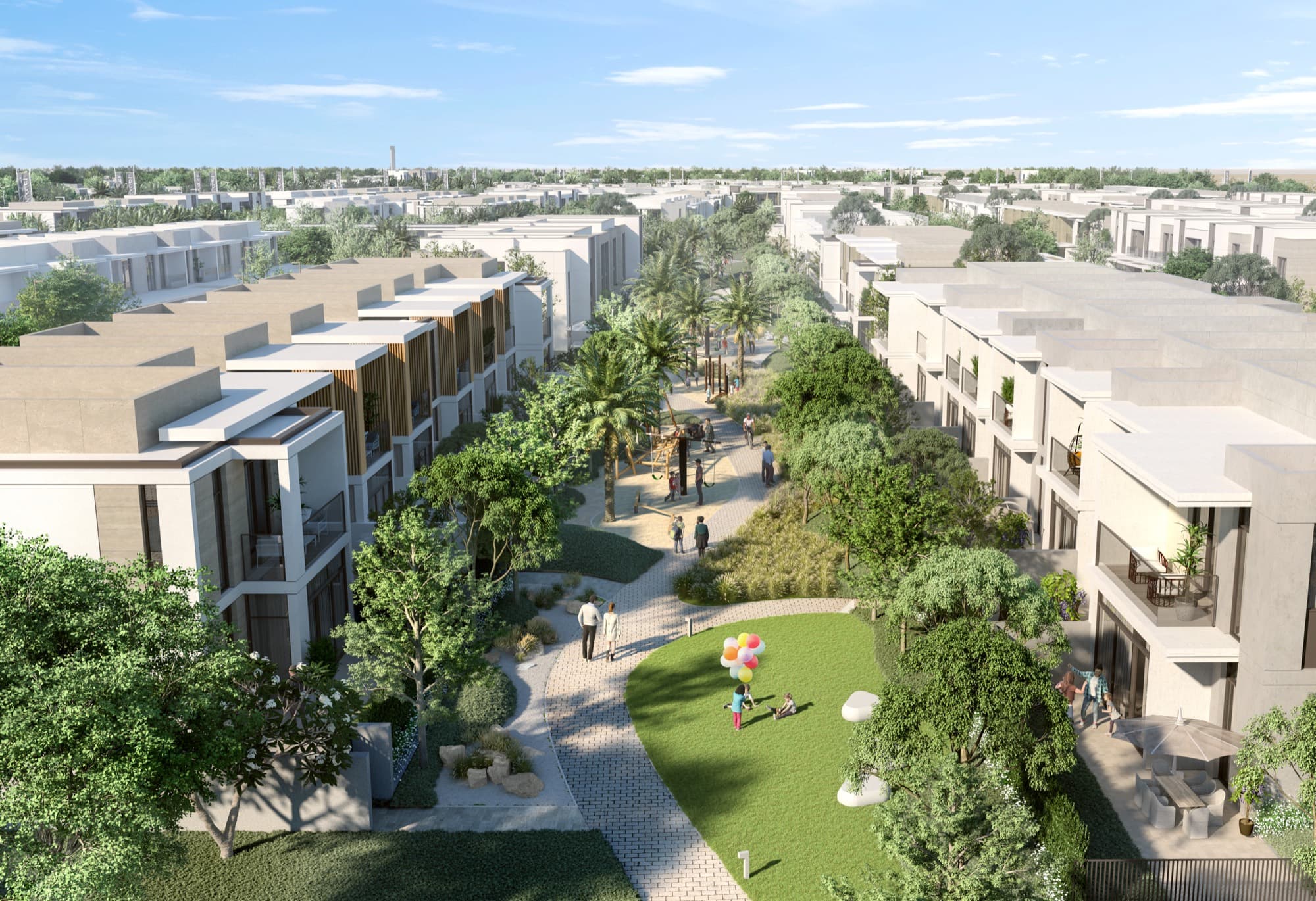
When buyers ask me about the cost of owning in Arabian Ranches 3, the headline price is only half the conversation. The other half is the annual service charge — the recurring fee every owner pays to keep the community looking and working the way it does. It is the money behind the manicured central park, the security at the gates, the lazy river that does not clean itself, and the streetlights that come on every evening.
I have lived in AR3 long enough to read these statements properly, and I have walked plenty of clients through theirs. The good news is that the system here is transparent and regulated. The less obvious news is that service charges are not a single flat number — they vary by cluster, by built-up area, and by whether you own a townhouse or a standalone villa. Getting your head around that before you buy is the difference between a budget that holds and a nasty surprise in year one.
This guide explains what service charges in AR3 actually cover, who sets them, how Emaar and the Dubai authorities regulate the rate, and how to read your own statement line by line. I have kept the per-square-foot figures deliberately general — rates are reviewed and registered with RERA, and you should always confirm the current figure for your specific cluster before you commit.
What service charges in AR3 actually pay for
Think of your service charge as your share of the running costs of everything outside your own four walls. In a master-planned community like AR3, that is a substantial list. Your contribution keeps the shared spaces maintained, safe and presentable all year round — and in Dubai's climate, that maintenance is constant rather than seasonal.
The big-ticket items are landscaping and irrigation (the central park, the planted verges, the date palms and the seasonal colour), 24-hour security and gate management, cleaning of common areas, and the upkeep of the headline amenities. In AR3 that means the lazy river, the swimming pools, the clubhouse, the padel and tennis courts, the sports courts, the cycling and jogging tracks and the children's play areas. None of that runs for free, and the standard is set high.
There is also a long list of less visible costs that owners often forget. These include common-area electricity and water, pumps and pool plant, road and pavement maintenance, waste management, pest control, insurance for the common property, CCTV and access systems, and a sinking-fund or reserve contribution for major future repairs and replacements. That reserve element matters: it is what stops the community from needing a sudden special levy when a big asset reaches the end of its life.
- Landscaping, irrigation and the central park
- 24/7 security, gatehouse and CCTV
- Maintenance of pools, the lazy river and clubhouse
- Padel, tennis and sports courts, plus tracks and play areas
- Common-area cleaning, lighting, water and power
- Road, pavement and infrastructure upkeep
- Insurance of common property and a reserve/sinking fund
Who sets the rate — Emaar, RERA and Mollak
Service charges in AR3 are not invented by a private management company in isolation. They sit inside Dubai's Jointly Owned Property (JOP) framework, governed by Law No. 6 of 2019 and overseen by the Real Estate Regulatory Agency (RERA), a division of the Dubai Land Department (DLD). That regulation is your protection as an owner.
In practical terms, Emaar Community Management — the community arm of the developer — prepares an annual budget for AR3 covering all the costs above. That budget has to be reviewed and approved before owners can be invoiced. Once approved, the rate is registered and the charges are issued and collected through Mollak, the DLD's central digital platform for service charges. Mollak is what makes the whole thing auditable: every dirham you pay is tracked against an approved budget rather than a number someone has plucked from the air.
As an owner you can view your approved charges, invoices, payment history and the community's financial reports through Mollak (accessible via the Dubai REST app and the DLD's channels). I always tell clients to register and actually log in — it is the cleanest way to confirm that what you are being asked to pay matches what has been formally approved.
Townhouse versus villa: why the bill differs
AR3 is a mix of townhouse clusters and standalone villa clusters, and that mix is the single biggest reason two owners pay very different annual figures. The townhouse clusters — Joy, Sun, Spring, Ruba, Bliss and Bliss 2, May, Raya, and Anya and Anya 2 — are 3 and 4-bed homes sharing closely-knit streets and amenity pockets. The villa clusters — Caya and Caya 2 (3, 4 and 5-bed standalone), June and June 2 (4 and 5-bed villas) and the branded Elie Saab Villas and Elie Saab Villas II (4 and 5-bed luxury) — are larger plots with more generous built-up areas.
Because service charges are calculated on a per-square-foot basis of built-up area, a bigger home simply carries a bigger total bill even at the same rate. A 5-bed Elie Saab villa will cost considerably more per year than a 3-bed townhouse in Joy, purely on floor area. The per-sqft rate itself can also vary between cluster types, reflecting the different infrastructure and amenity provision each one carries.
There is a useful nuance here for villa buyers. In many Emaar communities, larger standalone villa plots fall under a master-community or 'usage' charge structure rather than the denser shared-building model that drives high per-sqft rates in apartment towers. Villa owners generally avoid the steep common-area costs of lifts, lobbies and tower plant — which is one reason ranch-style living can be more economical per square foot than it first appears. Always confirm the exact structure for your specific cluster, as it shapes the final number.
A quick worked example
The maths is simple once you have two numbers. Take your home's built-up area in square feet and multiply it by the current RERA-registered rate per square foot for your cluster, and that gives you the annual figure before any reserve-fund or master-community lines are added in. The point to hold on to is the relationship: at any given rate, a larger home carries a proportionally larger total, so a five-bed villa will always sit well above a three-bed townhouse on floor area alone. I have deliberately not quoted a per-square-foot number here, because the rate is reviewed annually and differs by cluster — pull the live, approved figure for your exact cluster from the cluster page or Mollak before you build it into a budget.
How to read your service charge statement
A Mollak statement looks intimidating the first time, but it follows a logical structure. At the top you will find your unit reference and its registered built-up area — check this is correct, because the whole calculation hangs off it. The body breaks the total into cost categories (often grouped as general fund, master-community services, reserve fund and so on), each with a rate and a resulting amount.
Look for the rate per square foot, the period the invoice covers, and any opening balance or arrears carried forward. If you have bought mid-year, expect a pro-rata figure rather than a full annual charge. Many owners pay in instalments across the year, so your statement may show a schedule rather than one lump sum — useful for cash flow, but worth diarising so nothing slips.
The two layers to watch in a master community are the community or master charge (your share of the wider AR3 shared infrastructure and amenities) and any cluster-specific service charge. Add them together for your true annual cost. If a line item ever looks wrong, the regulated system gives you a route to query it — raise it with Emaar Community Management and cross-check against the approved budget on Mollak.
- Confirm your unit's built-up area is recorded correctly
- Note the rate per sqft and the billing period
- Separate the master-community charge from any cluster charge
- Check for arrears, opening balances or pro-rata adjustments
- Keep proof of payment — it is needed when you sell
How rates are reviewed over time
Service charges are not fixed forever. Emaar prepares a fresh budget each year, and the rate can move up or down depending on the actual cost of running the community, inflation in maintenance and utility costs, and the maturity of the development. New communities sometimes see rates settle as they hand over and reach full occupancy, and as amenities are fully commissioned and the reserve fund is built up.
Any change has to go back through the same approval process — it cannot simply appear on your bill. That regulatory check is precisely why the framework exists, and it is worth understanding before you assume next year's figure will match this year's. The DLD also publishes a Service Charge Index, which is a helpful sanity check on whether a community's rate sits in a reasonable band for its type and tier.
One Dubai-wide trend worth knowing: the authorities have begun approving multi-year fixed service fees in some master communities, giving owners more certainty over their forward costs. Whether and when that reaches AR3 will depend on Emaar and the DLD, but it is a positive direction of travel for anyone trying to budget several years ahead.
Budgeting as an AR3 owner
Whether you are buying to live in or to let, treat the service charge as a fixed annual line in your budget from day one. For a homeowner it is simply a cost of ownership, like a UK council tax in spirit — non-negotiable and best paid promptly to avoid arrears building up. For a landlord, it directly affects your net yield: the headline rent is not your return until you have deducted the service charge, and any sensible investment appraisal of AR3 should net it off.
A few practical habits save real money and hassle. Pay on time — Mollak tracks arrears, and unpaid charges can complicate or block a future sale, since clearance is part of the transfer process. Set aside the figure monthly rather than facing it as one annual shock. And before you buy, ask the seller for a recent statement and a clearance certificate so you know exactly what you are inheriting and that the account is clean.
Finally, keep the charge in proportion. It funds the very things that make AR3 desirable — the green spine, the lazy river, the courts and the security that hold the community's standards and, ultimately, its resale values. A well-run service charge is not a cost to resent; it is what protects your asset. If you would like me to pull the current registered rate for a specific cluster and sense-check it against your numbers, I am a resident here and happy to help.
Frequently Asked Questions
Service Charges — FAQs
How much are service charges in Arabian Ranches 3?+
There is no single number — service charges in AR3 are calculated per square foot of your home's built-up area, so a smaller townhouse pays much less in total than a larger villa even at the same rate. The per-sqft rate is set annually by Emaar, approved through RERA, and registered on the DLD's Mollak system. Because rates are reviewed and vary by cluster, always confirm the current registered figure for your specific cluster before budgeting rather than relying on a general estimate.
What do AR3 service charges cover?+
They cover the running costs of everything outside your own home: landscaping and irrigation, the central park, 24-hour security and gate management, common-area cleaning and lighting, and the upkeep of shared amenities such as the lazy river, swimming pools, clubhouse, padel and tennis courts, sports courts, tracks and play areas. They also fund common-area utilities, road and infrastructure maintenance, insurance of the common property, and a reserve or sinking fund for major future repairs.
Who sets and collects service charges in AR3?+
Emaar Community Management prepares the annual budget and collects the charge, but it does not act alone. The rate must be reviewed and approved under Dubai's Jointly Owned Property framework, regulated by RERA (part of the Dubai Land Department). Once approved, charges are issued and tracked through Mollak, the DLD's central platform, so every payment is matched to an approved budget.
Do townhouses and villas pay different service charges in AR3?+
Yes. Because the charge is based on built-up area, larger standalone villas in clusters like Caya, June and the Elie Saab Villas carry higher annual totals than the 3 and 4-bed townhouses in clusters such as Joy, Sun, Spring and Ruba. The per-sqft rate can also differ by cluster type, and villa owners often avoid the high common-building costs (lifts, lobbies, tower plant) seen in apartment developments.
What is Mollak and how do I check my AR3 service charges?+
Mollak is the Dubai Land Department's central digital system for managing and paying service charges on jointly owned property. As an AR3 owner you can use it — via the Dubai REST app and DLD channels — to view your approved charges, invoices, payment history and the community's financial reports. It is the cleanest way to confirm that what you are billed matches the formally approved budget.
Can service charges in AR3 go up?+
They can change in either direction. Emaar prepares a fresh budget each year, and the rate reflects the real cost of running the community, utility and maintenance inflation, and the development's maturity. Any change must go back through the RERA approval process before it can be billed. The DLD's Service Charge Index is a useful reference for checking whether a rate sits in a reasonable band, and some Dubai master communities are now moving toward multi-year fixed fees for greater certainty.
Are service charges paid annually or monthly in AR3?+
They are set as an annual figure, but many owners pay in instalments across the year, so your Mollak statement may show a payment schedule rather than a single lump sum. If you buy partway through the year, expect a pro-rata charge for the remaining period. Whichever applies, diarise the dates — arrears are tracked and can complicate a future sale.
Do unpaid service charges affect selling my AR3 home?+
Yes. Outstanding service charges must be cleared as part of the property transfer process, and a clearance certificate is typically required to complete a sale. Unpaid charges tracked on Mollak can therefore delay or block a transaction. When buying, ask the seller for a recent statement and clearance certificate so you inherit a clean account.
Are service charges worth it in a community like AR3?+
In my view, a well-run service charge is one of the things that protects your investment rather than erodes it. It funds the green central spine, the lazy river, the courts, the security and the overall standard of upkeep that make AR3 desirable to live in and to rent — all of which underpin resale value. The key is transparency, and the RERA and Mollak framework gives owners exactly that.